
Leveraging Swift’s Type System to Guard Code Quality and Prevent Errors
Swift’s robust type system is one of its greatest strengths, offering developers powerful tools to catch errors at compile time rather than runtime. In this blog, we’ll explore how to leverage it as a first line of defense against bugs.
Introduction
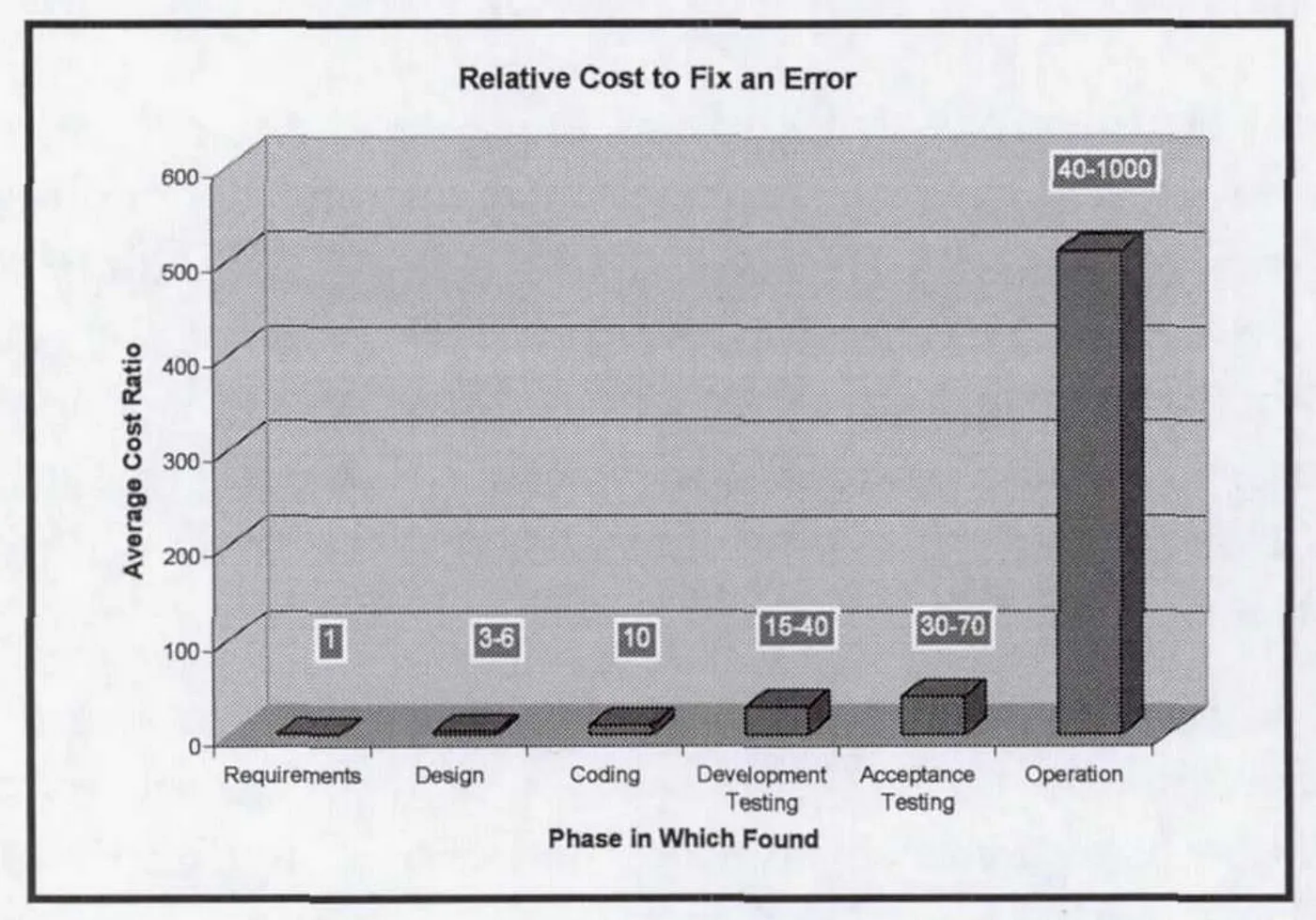
As developers, we’ve all experienced that sinking feeling when an app crashes in production due to an error that could have been caught earlier in the development process. Also, you might know the chart blow illustrating the cost to fix issues would increase dramatically at later stage. This is where Swift’s type system shines — it allows us to shift error detection from runtime to compile time.
When the compiler catches our mistakes, we get immediate feedback in our IDE. The compiler tells us exactly what’s wrong and where, often with suggestions on how to fix it. Swift’s type system is designed to be both powerful and pragmatic. Let’s dive into how we can leverage it to create safer, more maintainable code.
Understanding Phantom Types
Phantom types are a powerful pattern that allows us to encode additional type information without adding any runtime overhead. A phantom type is a generic parameter that doesn’t appear in the actual data structure but is used solely for type checking.
Let’s start with a basic example:
struct Tagged<Tag, Value> {
    let value: Value

    init(_ value: Value) {
        self.value = value
    }
}
Here, Tag is our phantom type - it’s not used in the implementation, only in the type signature. This allows us to create distinct types for values that would otherwise be the same:
// Define some tag types
enum UserIDTag {}
enum PostIDTag {}

// Create type aliases for convenience
typealias UserID = Tagged<UserIDTag, Int>
typealias PostID = Tagged<PostIDTag, Int>
// Usage
func fetchUser(id: UserID) { /* ... */ }
func fetchPost(id: PostID) { /* ... */ }
let entityID1 = UserID(123)
let entityID2 = PostID(456)
fetchUser(id: entityID1)  // Compiles fine
fetchUser(id: entityID2)  // Compiler error: Cannot convert value of type 'PostID' to expected argument type 'UserID'
Even though both UserID and PostID wrap Int values, the compiler treats them as distinct types, preventing us from accidentally passing a post ID where a user ID is expected.
Practical Applications of Phantom Types
Type-Safe Identifiers
The example above demonstrates one of the most common use cases for phantom types: creating type-safe identifiers. This is especially useful in large codebases where different entities might use the same underlying type for their IDs.
// Define more specific identifier types
typealias CommentID = Tagged<CommentIDTag, String>
typealias CategoryID = Tagged<CategoryIDTag, Int>

// Now functions can be very specific about what they accept
func associateComment(_ commentId: CommentID, withPost postId: PostID) { /* ... */ }
Enforcing State Transitions
Phantom types can also enforce valid state transitions in a state machine:
// State tags
enum Draft {}
enum Published {}
enum Archived {}

// Article with phantom type for state
struct Article<State> {
    let title: String
    let content: String
    // Other properties...
}

// State transition functions
extension Article where State == Draft {
    func publish() -> Article<Published> {
        Article<Published>(title: self.title, content: self.content)
    }
}
extension Article where State == Published {
    func archive() -> Article<Archived> {
        Article<Archived>(title: self.title, content: self.content)
    }
}
// Usage
let draftArticle = Article<Draft>(title: "Swift Type System", content: "...")
let publishedArticle = draftArticle.publish()
let archivedArticle = publishedArticle.archive()
// This won't compile:
// let invalidTransition = draftArticle.archive()
The compiler prevents invalid state transitions because the archive() method is only available on articles in the Published state.
Validation Tokens
Another powerful use of phantom types is for validated values:
enum Validated {}
enum Unvalidated {}

struct Email<ValidationState> {
    let rawValue: String
}
extension Email where ValidationState == Unvalidated {
    func validate() -> Email<Validated>? {
        // Perform some validation logic, take is as a very simple example rule
        let isValid = rawValue.contains("@") && rawValue.contains(".")
        return isValid ? Email<Validated>(rawValue: rawValue) : nil
    }
}
func sendEmail(to recipient: Email<Validated>) {
    // We can safely use the email here, knowing it's been validated
}
// Usage
let unvalidatedEmail = Email<Unvalidated>(rawValue: "[email protected]")
if let validatedEmail = unvalidatedEmail.validate() {
    sendEmail(to: validatedEmail)
}
// This won't compile:
// sendEmail(to: unvalidatedEmail)
This pattern ensures that only validated emails can be used in contexts that require validation.
Leveraging Associated Types and Protocols
Protocol-oriented programming combined with associated types creates powerful type-safe abstractions. Associated types allow protocols to express relationships between types without specifying concrete types.
protocol Repository {
    associatedtype Entity
    associatedtype ID

    func fetch(id: ID) -> Entity?
    func save(\_ entity: Entity) -> Bool
}

struct User {
    let id: String
    let name: String
}
struct UserRepository: Repository {
    typealias Entity = User
    typealias ID = String

    func fetch(id: String) -> User? {
        // Implementation...
        return nil
    }

    func save(_ entity: User) -> Bool {
        // Implementation...
        return true
    }
}
This ensures that each repository implementation maintains type consistency between its entities and IDs.
Type-Safe Builder Patterns using generic argument
Builder patterns in Swift can leverage the type system to prevent invalid configurations:
struct NetworkRequest<Resource> {
    let url: URL
    let method: HTTPMethod
    // Other properties...

    func execute(completion: (Resource) -> Void) {
        // Implementation...
    }
}
The type parameter Resource ensures that the request and its result handling are type-consistent.
Result Builders in Swift
Swift’s result builders bring DSL capabilities with compile-time type checking. SwiftUI is the most well-known example, but you can create your own result builders:
@resultBuilder
struct ArrayBuilder<Element> {
    static func buildBlock(\_ components: Element...) -> \[Element\] {
        return components
    }

    static func buildOptional(\_ component: \[Element\]?) -> \[Element\] {
        return component ?? \[\]
    }

    static func buildEither(first component: \[Element\]) -> \[Element\] {
        return component
    }

    static func buildEither(second component: \[Element\]) -> \[Element\] {
        return component
    }
}

func makeArray<T>(@ArrayBuilder<T> \_ content: () -> \[T\]) -> \[T\] {
    return content()
}
// Usage
let numbers = makeArray {
    1
    2
    if true {
        3
    }
    if false {
        4
    } else {
        5
    }
}
// numbers = [1, 2, 3, 5]
Result builders combine the expressiveness of DSLs with the safety of Swift’s type system. You can check more on this topic here.
Generic Constraints and Where Clauses
Generic constraints allow us to express complex type relationships:
extension Collection where Element: Identifiable {
    func findElement(withID id: Element.ID) -> Element? {
        first { $0.id == id }
    }

    func containsElement(withID id: Element.ID) -> Bool {
        contains { $0.id == id }
    }
}
// Usage with any collection of Identifiable elements
struct Product: Identifiable {
    let id: Int
    let name: String
}
let products: [Product] = [
    Product(id: 1, name: "iPhone"),
    Product(id: 2, name: "iPad")
]
let product = products.findElement(withID: 1)
The constraints ensure that these extension methods are only available on collections of Identifiable elements.
Opaque Return Types and ‘some’ Keyword
Swift’s some keyword allows functions to return a specific type that conforms to a protocol without exposing the concrete type:
protocol Animal {
    func makeSound() -> String
}

struct Dog: Animal {
    func makeSound() -> String {
        return "Woof!"
    }
}
struct Cat: Animal {
    func makeSound() -> String {
        return "Meow!"
    }
}
func getAnimal(isDog: Bool) -> some Animal {
    return isDog ? Dog() : Cat()
}
let animal = getAnimal(isDog: true)
print(animal.makeSound())  // "Woof!"
The some keyword preserves type information, enabling compiler optimizations while maintaining the abstraction of returning any Animal.
Value Types vs Reference Types
Swift’s emphasis on value types helps prevent shared state bugs:
struct User {
    var name: String
    var email: String
}

// With a struct (value type), this creates a copy
var user1 = User(name: "Alice", email: "[email protected]")
var user2 = user1
user2.name = "Bob"
print(user1.name)  // "Alice" - Original is unchanged
print(user2.name)  // "Bob" - Only the copy changed
Value types are copied when assigned or passed to functions, which eliminates entire categories of bugs related to shared mutable state. You can check more on this topic here.
Enum Exhaustiveness Checking
Swift’s compiler automatically ensures that switch statements on enums handle all possible cases:
enum NetworkError: Error {
    case invalidURL
    case serverError(code: Int)
    case noData
}

func handleNetworkError(_ error: NetworkError) -> Never {
    switch error {
    case .invalidURL:
        fatalError("Invalid URL provided")
    case .serverError(let code):
        fatalError("Server error: \\(code)")
    case .noData:
        fatalError("No data received")
    }
}
If we add a new case to NetworkError, the compiler will force us to update handleNetworkError because it must be exhaustive.
The Never Type
Swift’s Never type represents values that never occur, which can be used to indicate functions that don’t return normally:
func crashApp() -> Never {
    fatalError("Application terminated due to critical error")
}
The Never return type tells Swift that these functions won’t return normally, which can help with control flow analysis and type checking in other parts of your code. For example, the following code compiles, but won’t compile if we remove -> Never signature from crashApp method definition.
func crashApp() -> Never {
    fatalError("Application terminated due to critical error")
}

func doSomething(condition: Bool) -> String {
    if condition {
        return "Success"
    } else {
        crashApp() // With -> Never, compiler knows this never returns
        // No "return" needed here because this path never completes
    }
}
The benifit of using Never here are:
- Compiler guarantees: The
Neverreturn type tells the Swift compiler that control flow will never return from this function. The compiler can use this information for better control flow analysis. - Type-checking benefits: With
-> Never, the compiler knows for certain that any code after a call to this function is unreachable, which affects exhaustiveness checking in pattern matching and conditional code. - Self-documentation: The
Neverreturn type clearly communicates to other developers that this function will never return normally. - Semantic correctness: Using
-> Neveris semantically more accurate when a function is designed to never return.
Custom Operators for Type Safety
Custom operators with type constraints can make code more readable while maintaining type safety:
infix operator +=: AdditionPrecedence

// Specialized operator for appending to arrays
func += <Element>(lhs: inout [Element], rhs: Element) {
    lhs.append(rhs)
}
// Different implementation for dictionaries
func += <Key, Value>(lhs: inout [Key: Value], rhs: (Key, Value)) {
    lhs[rhs.0] = rhs.1
}
// Usage
var numbers = [1, 2, 3]
numbers += 4  // \[1, 2, 3, 4\]
var dict = \["a": 1, "b": 2\]
dict += ("c", 3)  // \["a": 1, "b": 2, "c": 3\]
The compiler selects the appropriate implementation based on the types involved.
Property Wrappers for Validation
Property wrappers provide a way to reuse validation logic:
@propertyWrapper
struct Validated<T> {
    private var value: T
    private let validator: (T) -> Bool

    var wrappedValue: T {
        get { return value }
        set {
            precondition(validator(newValue), "Invalid value")
            value = newValue
        }
    }

    init(wrappedValue: T, validator: @escaping (T) -> Bool) {
        precondition(validator(wrappedValue), "Invalid initial value")
        self.value = wrappedValue
        self.validator = validator
    }
}

struct User {
    @Validated(validator: { $0.count >= 3 })
    var username: String

    @Validated(validator: { $0.contains("@") })
    var email: String
}
// Usage
var user = User(username: "Bob", email: "[email protected]")
// These will compile but trigger precondition failures at runtime:
// user.username = "B"  // Too short
// user.email = "invalid"  // Missing @
Property wrappers encapsulate validation logic that can be reused across your codebase. You can check more on this topic here.
Type-Level Programming Techniques
Swift allows for some type-level programming techniques, particularly with enums that have associated values:
// Type-level representation of list
enum List<Element> {
    case empty
    indirect case cons(Element, List<Element>)
}

// Append operation at the type level
extension List {
    func append(_ element: Element) -> List<Element> {
        switch self {
        case .empty:
            return .cons(element, .empty)
        case .cons(let head, let tail):
            return .cons(head, tail.append(element))
        }
    }
}
// Usage
let list = List<Int>.empty
    .append(1)
    .append(2)
    .append(3)
This approach lets us represent and manipulate data structures at the type level, with full compiler verification.
Testing Type Safety
Testing type safety features is different from traditional unit testing because many type constraints are verified at compile time rather than runtime. Here’s how you can approach testing your type system:
Examples for Type Safety(Using XCTest)
class TypeSafetyTests: XCTestCase {
    // Test phantom type ID safety
    func testUserIDAndPostIDAreDifferent() {
        let userId = UserID(123)
        let postId = PostID(123)

        // This should not compile, confirming type safety:
        // XCTAssertFalse(userId == postId)

        // Instead, test that types are what we expect
        XCTAssertTrue(type(of: userId) == UserID.self)
        XCTAssertTrue(type(of: postId) == PostID.self)

        // Test that the underlying values are accessible but types remain distinct
        XCTAssertEqual(userId.value, 123)
        XCTAssertEqual(postId.value, 123)

        // Demonstrate that functions requiring specific types work correctly
        func requiresUserID(_ id: UserID) -> Bool { return true }
        XCTAssertTrue(requiresUserID(userId))

        // This would not compile, confirming type safety:
        // requiresUserID(postId)
    }

    // Test state machine transitions
    func testArticleStateTransitions() {
        let draft = Article<Draft>(title: "Title", content: "Content")

        // Test state transition works
        let published = draft.publish()
        XCTAssertTrue(type(of: published) == Article<Published>.self)

        // Test further transition
        let archived = published.archive()
        XCTAssertTrue(type(of: archived) == Article<Archived>.self)

        // These should not compile, confirming our state machine integrity:
        // draft.archive()
        // archived.publish()
    }

    // Test validation pattern with phantom types
    func testEmailValidation() {
        let unvalidatedEmail = Email<Unvalidated>(rawValue: "[email protected]")

        // Test valid email can be validated
        XCTAssertNotNil(unvalidatedEmail.validate())

        if let validatedEmail = unvalidatedEmail.validate() {
            // Test type is correct after validation
            XCTAssertTrue(type(of: validatedEmail) == Email<Validated>.self)

            // Test that validatedEmail can be used where required
            func sendMail(to: Email<Validated>) -> Bool { return true }
            XCTAssertTrue(sendMail(to: validatedEmail))

            // This would not compile, confirming type safety:
            // sendMail(to: unvalidatedEmail)
        }

        // Test invalid email
        let invalidEmail = Email<Unvalidated>(rawValue: "not-an-email")
        XCTAssertNil(invalidEmail.validate())
    }

    // Test generic constraints
    func testCollectionExtensions() {
        struct TestItem: Identifiable {
            let id: String
            let name: String
        }

        let items = [
            TestItem(id: "1", name: "Item 1"),
            TestItem(id: "2", name: "Item 2"),
            TestItem(id: "3", name: "Item 3")
        ]

        // Test our collection extension works
        let foundItem = items.findElement(withID: "2")
        XCTAssertNotNil(foundItem)
        XCTAssertEqual(foundItem?.name, "Item 2")

        // Test containsElement works
        XCTAssertTrue(items.containsElement(withID: "1"))
        XCTAssertFalse(items.containsElement(withID: "4"))
    }
}
Performance Considerations
One of the beautiful aspects of phantom types and many other type system techniques is that they add zero runtime overhead. The type information is used by the compiler for verification but doesn’t exist at runtime.
However, complex type constraints can increase compile time. Finding the right balance is important:
// Simpler but still type-safe
struct TypedID<Tag>: RawRepresentable, Hashable {
    let rawValue: String

    init(rawValue: String) {
        self.rawValue = rawValue
    }
}

// Usage
enum UserTag {}
enum PostTag {}
typealias UserID = TypedID<UserTag>
typealias PostID = TypedID<PostTag>
This approach achieves the same type safety with less generic complexity, potentially improving compile times.
Conclusion
Swift’s type system is a powerful tool at our disposal for code quality. By leveraging phantom types, associated types, opaque return types, and other techniques, we can catch errors at compile time rather than runtime.
The key benefits include:
- Earlier error detection: Errors are caught during development, not in production.
- Self-documenting code: Type signatures clearly communicate intent and relationships.
- Refactoring confidence: The compiler ensures correctness when changing code.
- Zero runtime overhead: Most of these techniques have no performance impact at runtime.
As you incorporate these patterns into your codebase, start small and focus on areas where type confusion has caused bugs in the past. Over time, you’ll develop an intuition for where these techniques provide the most value.
Remember, the goal isn’t to create the most complex type system possible, but to leverage Swift’s type system to prevent bugs and make your codebase more maintainable.
Sharing is caring!