
Firebase Testing agent leveraging AI

Mobile app testing has always been a critical yet challenging aspect of Android development. Firebase App Testing Agent emerges as a powerful solution to automate and streamline this process, making it easier for development teams to maintain high-quality standards throughout their release cycles.
What is Firebase App Testing Agent
Firebase App Testing Agent is an intelligent, automated testing solution that works seamlessly with Firebase App Distribution. Leveraging AI, it simplifies the process of writing test cases, making automated testing faster, smarter, and more accessible than ever.
How it works
-
Natural Language Test Goals: Define test cases using plain English (e.g., “Search for a hotel in Paris and open the first result”). These are called test goals.
-
AI-Driven Interaction: The agent interprets your goals and simulates user interactions on Android devices in Firebase Test Lab. It understands UI elements and can navigate through the app intelligently.
-
Step-by-Step Execution Each test can be broken into steps, each with its own goal, optional hints (to guide tricky UI flows), and success criteria (to define what a “pass” looks like).
-
No SDK Required No need to modify the app or add SDKs. Just upload your APK or AAB to Firebase App Distribution.
-
Test Results & Debugging After execution, the agent provides detailed results, including screenshots, step logs, and explanations of what actions were taken and why a test passed or failed.
How to write test cases
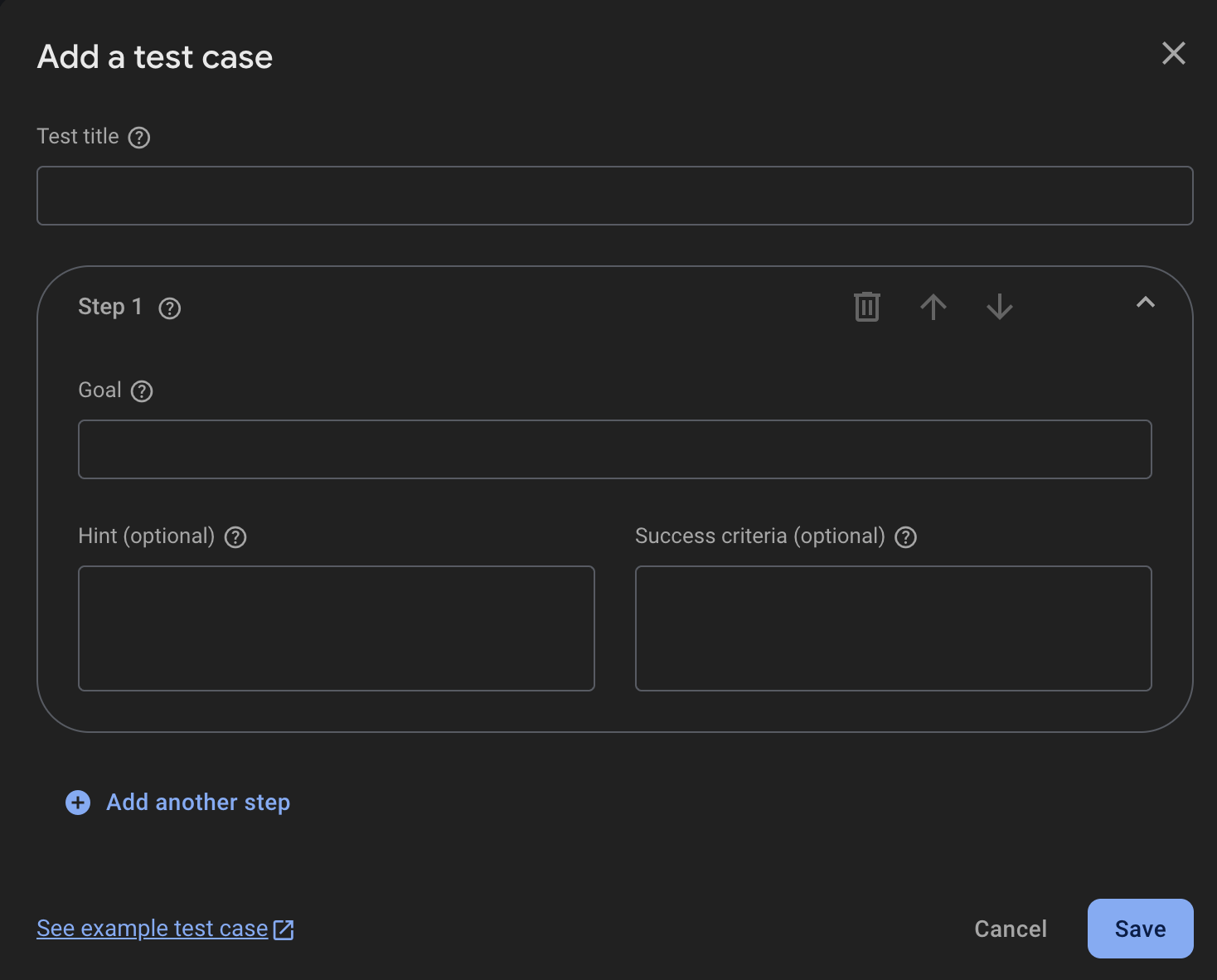
- Test title: the test name.
- Step: Define the test steps.
- Goal: Define what to do in this step.
- Hint: Provids hints to AI to bettet guide testing agent to run the UI automation if needed.
- Success criteria: Define the acceptance criteria.
Powered by AI
Unlike traditional automation frameworks like Appium or Selenium, Firebase Testing Agent is powered by AI, allowing developers to write test cases using natural language. In my experience, I was able to guide the UI flow without explicitly defining each individual step—demonstrating the agent’s ability to intelligently interpret and execute high-level instructions.
This could significantly transform the landscape of app automation testing. With its AI-driven natural language capabilities, writing automated test cases is no longer the sole domain of developers. Team members across roles—such as product owners, business analysts, and QA specialists—can now actively participate in the testing process. This shift fosters a more collaborative, efficient, and inclusive approach to quality assurance.
Limitation
-
Android apps only At the moment, The testing agent only supports Anddroid apps. It would be great the test cases can be shared for both platforms.
-
Lack of test case structure For all the test cases now, there’s no dependency structures, which means, if there is no way to share steps among test cases and we need to write them multiple times. This could a challenge for a big project where we need to have many test cases covering the features.
Conclusion
Firebase App Testing Agent represents a significant leap forward in mobile app testing, democratizing automated testing through its AI-powered natural language approach. By eliminating the need for complex test frameworks and allowing team members across different roles to contribute to testing efforts, it has the potential to revolutionize how development teams approach quality assurance.
While the current limitations—Android-only support and lack of modular test case structures—may pose challenges for larger projects or cross-platform development teams, the core innovation of natural language test automation is compelling. As Firebase continues to evolve this tool, addressing these limitations could make it an indispensable part of the mobile development toolkit.
For teams looking to reduce the technical barrier to automated testing while maintaining comprehensive coverage, Firebase App Testing Agent offers a promising path forward. Its ability to intelligently interpret high-level goals and execute complex UI flows suggests we’re moving toward a future where quality assurance becomes more collaborative, accessible, and efficient across the entire development lifecycle.
Sharing is caring!